
Buy company addresses in St. Gallen
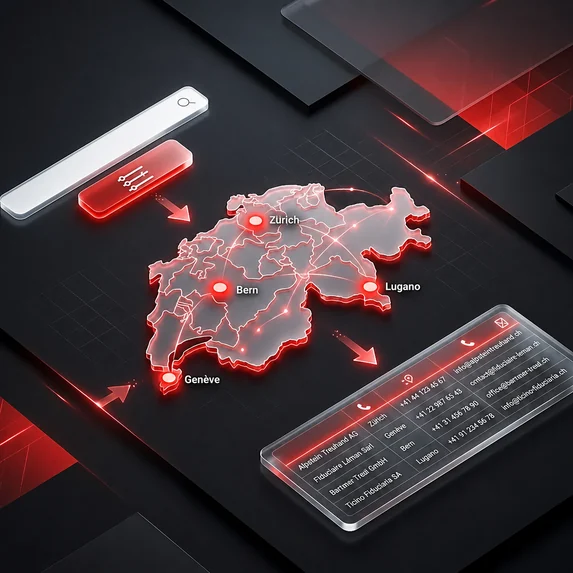
St. Gallen connects a broad SME base with insurance, business software, textiles and industrial companies across Eastern Switzerland. SwissB2B researches the company data that matches your market and targeting criteria.
B2B market St. Gallen: economy and industries
Eastern Switzerland's economic hub with a textile heritage
St. Gallen is an economic and cultural centre of Eastern Switzerland and an important reference point for Appenzell, the Rhine Valley and the Lake Constance region. Its proximity to Vorarlberg, southern Germany and Liechtenstein also matters to export-oriented companies. International access runs via St. Gallen-Altenrhein Airport and the motorway connection to Zurich.
St. Gallen and nearby Herisau have a long textile and embroidery tradition. The region has since developed into a diversified business location. The University of St. Gallen (HSG) supports a network of consulting firms, financial service providers and startups, while Empa contributes applied research in materials science and technology.
Insurance, software and industrial companies
The textile and apparel industry remains a hallmark of St. Gallen. The Textile Museum documents its history, while companies such as Forster Rohner and Jakob Schlaepfer continue to produce fabrics and embroidery. Alongside this, an IT and technology sector has developed. Abacus Research is headquartered in Wittenbach near St. Gallen, and specialised software firms and digital agencies complement the regional business base.
Helvetia Insurance is headquartered in St. Gallen. The Bühler Group in nearby Uzwil and Stadler Rail in Bussnang also shape the region and its supplier networks in mechanical engineering, food technology and rail transport.
HSG spin-offs and regional innovation
St. Gallen’s business base includes many medium-sized businesses and specialised firms in financial consulting, insurance brokerage and IT services. Initiatives such as the Startfeld innovation centre and IT-Cluster Ostschweiz support entrepreneurship and digital businesses in the region.
The combination of HSG-related firms, established industrial companies and newer technology businesses makes St. Gallen a varied B2B market. Events such as the St. Gallen Symposium and Startfeld programmes provide additional points of contact.
A credible approach in St. Gallen starts with a clearly defined region and industry. German is suitable for most local SMEs, while international or HSG-related organisations may also work in English.
Key industries
- Textiles and embroidery (Forster Rohner, Jakob Schlaepfer)
- Business software and ERP (Abacus Research, Wittenbach)
- Insurance and financial services (Helvetia Insurance)
- Machinery and rail (Bühler Group in Uzwil, Stadler Rail in Bussnang)
- Consulting and startups around the University of St. Gallen
- Applied research and materials (Empa)
Use cases
- Export-oriented outreach that pairs St. Gallen with the nearby Vorarlberg, southern Germany and Liechtenstein markets.
- Supplier prospecting into the machinery and rail chain around Uzwil and Bussnang.
- Appointment setting with HSG spin-offs and IT-Cluster Ostschweiz members for a B2B software or service provider.
Targeting examples
- Machinery and manufacturing SMEs in the St. Gallen and Rhine Valley area with 20 to 200 employees; Company data PLUS or PRO can add a procurement or engineering contact.
- IT and software firms around St. Gallen and Wittenbach with 5 to 60 staff, addressed to the CTO or managing director.
- Insurance brokers and financial-consulting firms in the city with fewer than 40 employees; Company data PLUS or PRO can add a verified email.
Data-quality notes
- Eastern Switzerland spans several cantons (St. Gallen, both Appenzells, Thurgau, Graubünden), so a St. Gallen selection should define whether it means the city, the canton or the wider region.
- The border location means some prospects are registered in Liechtenstein, Austria or Germany; Swiss data should exclude these unless cross-border reach is wanted.
- Anchor firms register headquarters in surrounding municipalities (Bühler in Uzwil, Stadler in Bussnang, Abacus in Wittenbach) rather than the city itself, so city-only filters miss them.
- At smaller companies, the owner may remain the relevant decision-maker; Company data PLUS or PRO supports role targeting.
Planning B2B outreach in Switzerland? Have us research company addresses in St. Gallen, run a personalised direct-mail campaign or target new Swiss company formations. Looking beyond St. Gallen? Compare our Swiss company-data packages for selections across cities, cantons and industries. You can also explore company addresses in Zug.
Starter packages & prices
100 records tell you more than any promise. Try us with a starter package.
Firmendaten
Includes selection by region, industry or keyword
100 company records
CHF 0.49 per record
Suitable for: Mailings to company addresses and calls through the company switchboard
- Company name
- Street, postcode, town and canton
- Industry
- Telephone number
- Company email address
- Website
- Google rating and number of reviews
- Delivered as Excel and CSV files
Firmendaten PLUS
Contact person and verified email
100 company records
CHF 0.99 per record
Suitable for: Personalised outreach to the right contact person
- All Firmendaten fields
- Name of the relevant contact person
- Role
- Verified business email address
Firmendaten PRO
With a relevant contact person and company-size filtering
100 company records
CHF 1.49 per record
Suitable for: Target groups narrowed by company size
- All Firmendaten PLUS fields
- Flexible company-size filter, e.g. at least 10, at least 1,000, or 50–500 employees
Enterprise
Complex selection and custom requirements
Suitable for: Complex target groups and recurring deliveries
- Filter by number of employees
- Filter by revenue
- Complex combinations of regions, industries and keywords
- Several contact persons or special roles
- Recurring deliveries
- Additional data fields or specific exclusions
- CRM integration or custom data transfer
Prices by data volume
| Package | 100 records | 250 records | 500 records | 1'000 records | Delivery |
|---|---|---|---|---|---|
| Firmendaten | CHF 49.-CHF 0.49/record | CHF 116.-CHF 0.46/record | CHF 221.-CHF 0.44/record | CHF 417.-CHF 0.42/record | 2 working days |
| Firmendaten PLUS | CHF 99.-CHF 0.99/record | CHF 235.-CHF 0.94/record | CHF 446.-CHF 0.89/record | CHF 842.-CHF 0.84/record | 3 working days |
| Firmendaten PRO | CHF 149.-CHF 1.49/record | CHF 354.-CHF 1.42/record | CHF 671.-CHF 1.34/record | CHF 1'267.-CHF 1.27/record | 4 working days |
Frequently asked questions about company addresses in St. Gallen
St. Gallen is strong in textiles and apparel, IT and software (for example Abacus Research), insurance (Helvetia headquarters), financial consulting and education. The HSG network also continuously produces new consulting and technology companies.
Yes. We supply company addresses from the city of St. Gallen, from the entire canton and, if required, from adjacent regions such as Thurgau, Appenzell and the Rhine Valley. You can narrow your selection by postal code, industry and company size.
Company data PLUS or PRO can include direct contacts and job titles. This allows you to target managing directors, partners or department heads in St. Gallen's consulting environment.
St. Gallen has a broad base of SMEs alongside larger employers. The relevant number depends on whether your selection covers the city, the canton or the wider Eastern Switzerland region.
Yes. Dozens of textile companies remain active in and around St. Gallen, including embroidery firms, lace manufacturers and providers of technical textiles. SwissB2B can select this niche precisely.
More questions about ordering, delivery and legal topics: full FAQ.
Order company addresses from St. Gallen
From CHF 49 for 100 current, enriched company records. Researched to your criteria, not exported from a generic database.