
Company addresses in Lausanne
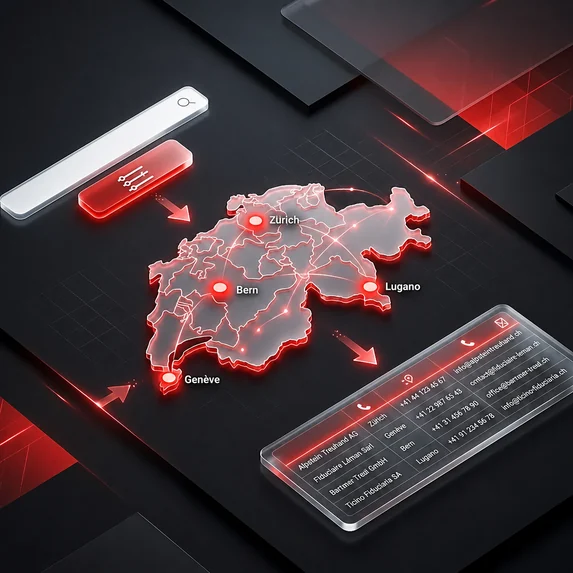
Company data for Lausanne, sorted by industry, region and company size. Researched B2B records for international operations, Health Valley biotech, Vaud finance and service SMEs across the Lake Geneva region.
B2B market Lausanne: economy and industries
Lausanne, capital of Vaud and a services hub
Lausanne has a strongly service-based economy. Cantonal administration, a university hospital, higher-education institutions and international business operations share a compact area extending from the historic centre to the Sébeillon and Blécherette districts.
The wider Canton of Vaud adds multinationals, public institutions and a broad network of local providers. Within the same sector, these organisations can have very different structures and purchasing needs.
From the Philip Morris seat to Health Valley
International business operations give Lausanne much of its global profile. Philip Morris International runs its Operations Center on Avenue de Rhodanie, while its corporate headquarters are in Stamford and its main Swiss research centre is in Neuchâtel. Nestlé Nespresso has its head office in the city. The CHUV is one of Switzerland's university hospitals, while Banque Cantonale Vaudoise, Vaudoise Assurances and Retraites Populaires anchor the regional financial sector.
EPFL and its innovation park are central to the Lake Geneva life-sciences and technology ecosystem, often described as Health Valley. Lausanne is also home to the International Olympic Committee and numerous international sports federations. Together, these organisations contribute to demand for event, media, legal, travel and professional services.
Vaud service SMEs as a prospecting target
Beyond the headline names, Lausanne has a broad base of service SMEs: fiduciaries, agencies, consultancies, IT providers, engineering offices and suppliers to the medical sector. The Flon and station area include agencies and startups, while Malley, Renens and Crissier have more trades and light industry.
Accurate targeting separates the city from the district and wider Lake Geneva region and distinguishes headquarters from operating companies. Records for light-industry suppliers in Renens serve a different campaign from data for agencies in the Flon. SwissB2B researches the data from public sources and delivers it with a research date, without a subscription or expiring credits.
A serious B2B approach in Lausanne calls for precise targeting and a clear French-language message, with a first contact that fits the mix of local SMEs, public institutions and international headquarters in the canton.
Key industries
- Corporate headquarters and multinationals
- Life sciences and biotech (Health Valley)
- Vaud finance and insurance
- Health, university hospital and medtech
- International sport and organisations
- IT, engineering and SME services
Use cases
- Market entry into French-speaking Switzerland for a B2B provider that wants to approach the service SMEs of Lausanne and the Lake Geneva arc.
- Targeted prospecting of biotech and medtech companies in Health Valley and their suppliers.
- Campaigns aimed at the fiduciaries, agencies and engineering offices of the Lausanne district; Company data PLUS or PRO can add the relevant decision-maker.
Targeting examples
- Consultancies and fiduciaries in Lausanne with 5 to 50 staff, approached at partner or director level.
- Biotech and medical-device companies in the Lausanne district, excluding public institutions and universities.
- IT providers and digital agencies in the Lausanne region; Company data PLUS or PRO can add a verified email address.
Data-quality notes
- Many multinationals run a headquarters or research centre in Lausanne, so the seat has to be separated from real operating activity.
- The CHUV, EPFL and the cantonal administration weigh heavily on employment but are not commercial targets: they can be excluded from the data.
- The labour market is regional and partly cross-border; some decision-makers work from Geneva, Nyon or neighbouring France.
- The working language is French for local SMEs, but English dominates in international headquarters, which changes the contact channel.
Planning B2B outreach in Switzerland? Have us research company addresses in Lausanne, run a personalised direct-mail campaign or target new Swiss company formations. Looking beyond Lausanne? Compare our Swiss company-data packages for selections across cities, cantons and industries. You can also explore company addresses in Lugano.
Starter packages & prices
100 records tell you more than any promise. Try us with a starter package.
Firmendaten
Includes selection by region, industry or keyword
100 company records
CHF 0.49 per record
Suitable for: Mailings to company addresses and calls through the company switchboard
- Company name
- Street, postcode, town and canton
- Industry
- Telephone number
- Company email address
- Website
- Google rating and number of reviews
- Delivered as Excel and CSV files
Firmendaten PLUS
Contact person and verified email
100 company records
CHF 0.99 per record
Suitable for: Personalised outreach to the right contact person
- All Firmendaten fields
- Name of the relevant contact person
- Role
- Verified business email address
Firmendaten PRO
With a relevant contact person and company-size filtering
100 company records
CHF 1.49 per record
Suitable for: Target groups narrowed by company size
- All Firmendaten PLUS fields
- Flexible company-size filter, e.g. at least 10, at least 1,000, or 50–500 employees
Enterprise
Complex selection and custom requirements
Suitable for: Complex target groups and recurring deliveries
- Filter by number of employees
- Filter by revenue
- Complex combinations of regions, industries and keywords
- Several contact persons or special roles
- Recurring deliveries
- Additional data fields or specific exclusions
- CRM integration or custom data transfer
Prices by data volume
| Package | 100 records | 250 records | 500 records | 1'000 records | Delivery |
|---|---|---|---|---|---|
| Firmendaten | CHF 49.-CHF 0.49/record | CHF 116.-CHF 0.46/record | CHF 221.-CHF 0.44/record | CHF 417.-CHF 0.42/record | 2 working days |
| Firmendaten PLUS | CHF 99.-CHF 0.99/record | CHF 235.-CHF 0.94/record | CHF 446.-CHF 0.89/record | CHF 842.-CHF 0.84/record | 3 working days |
| Firmendaten PRO | CHF 149.-CHF 1.49/record | CHF 354.-CHF 1.42/record | CHF 671.-CHF 1.34/record | CHF 1'267.-CHF 1.27/record | 4 working days |
Frequently asked questions about company addresses in Lausanne
Yes. We filter life-sciences firms around EPFL and Health Valley by fields such as biotech, medical devices, diagnostics and research services. Company data PLUS and PRO can add a relevant contact person for the requested role.
You decide. These large employers can be included as a target or excluded so the data contains only private commercial companies in Lausanne.
Yes. The research can split headquarters, research centres and operating companies when that distinction matters for your campaign.
Yes. You can combine Lausanne with Geneva, Montreux, Nyon, the Lake Geneva region or other cantons in a single order, by language and by industry.
Once the targeting is agreed, delivery takes 2 working days for Company data, 3 for Company data PLUS and 4 for Company data PRO.
Yes. Company data includes a company phone number, company email, website, industry, language, canton, Google reviews and a research date. PLUS and PRO add the relevant contact person, role and a verified personal business email where it is publicly available.
More questions about ordering, delivery and legal topics: full FAQ.
Order company addresses from Lausanne
From CHF 49 for 100 current, enriched company records. Researched to your criteria, not exported from a generic database.